Showing posts with label blogging. Show all posts

Thursday, November 24, 2011

Wealth Creation Through Blogging

This guest post is by Shaun of MoneyCactus.


There’s a blog for just about everything these days. Some are a lot better than others, but I’m going to go out on a limb here and say that any blog has the potential to become great.


It is completely possible to find a niche and an interested audience if you are serious enough about it yourself.

Wealthy Image copyright Maria Goncalves - Fotolia.com

Some Internet entrepreneurs are better at doing this than others and make the process look easy. While many of these great bloggers definitely have a talent for what they do, the fundamentals of how they go about it really don’t change too much at all.

I guess now is probably a good time to tell you that this is not an article about making money from your blog. Before you even get to this stage you need to develop a strategy, understand your market, and allocate your resources. Good bloggers understand this. They are the same principles that you would use when making any investment.


If you want to create a blog that is successful, then these basic wealth creation fundamentals should go a long way to getting you there.


People often make bad investment decisions, most of which are based on their emotions or—even worse—a “gut feeling.” Bloggers can make this mistake when selecting a niche as well.


A hobby is not an investment, it is just another way to spend your money. You do not need to be good at a hobby. Really, it’s just something you do to waste time.


The best investments are made in things that you are very knowledgeable about. Don’t confuse something you like the sound of with something you know a lot about. In order to create an authority site and demonstrate social proof, you need to know enough about your area of interest to attract readers. You do not need to be an expert, but you do need to have a knack for delivering information that makes readers want to keep coming back.


Do your research before anything else. You wouldn’t waste time and money on a dud investment; don’t do the same with a blog.


If you told me I had an imaginary sum of $1,000 and then asked me to pick some stocks to watch over a year as a way to practice my investing skills, I probably wouldn’t have any trouble making a choice and playing the game. If you told me I had to actually put my own money on the line, the chances are I would be studying those stocks very closely and sweating every decision I made.


If you are really serious about blogging, then you need to have a stake in the game. It doesn’t need to be big money, but spending some money on your blog will help keep you motivated as losing it is never fun.


Forget Blogger, WordPress.com, Tumblr, or any of those other free platforms (believe me, I learned the hard way). Yes they can be useful and they are simple to set up, but if you plan to use your blog as a means to generate income, then invest in yourself, and pay the small amount of money it costs to get a unique domain name and a self-hosted account.


Tithing is practiced by many of the world’s richest people, but you don’t need mega bucks to start giving. You can give in lots of ways that help others, and the nice thing is that giving has a habit of coming back to you in lots of other ways.


Bloggers are quite possibly the nicest people I know. It is amazing how approachable they are, and what they will do to help or provide advice if you ask them. If you spend some time hanging out in the blogosphere, then you will quickly realize that the whole network runs on love. Bloggers write about things they love, people follow the things they love, and the better you are at showing people how to do what they want, the more love you will get in return.


If you can find ways to be ridiculously useful to others within your niche and over-deliver on your promises, you will attract people organically. Unsurprisingly, bloggers follow other bloggers in their niche, so reach out and give to a fellow blogger or combine your powers to offer even more.


In order to spread risk, investors often use different vehicles to grow their wealth. The same principles apply to blogging: a nice spread of traffic will ensure you are not reliant on any one stream.


There are many ways to do this, and you might have your own methods, but here are a few things that I have been doing to grow my audience.


There are ways to help make your blog posts as targeted as possible by focusing on keywords and employing other SEO tactics. But, to be perfectly honest, the most visited pages on my site are poorly optimized (I really should do something about that).


Instead, I write about what is affecting me, and I try to solve the problem. Funnily enough there are lots of other people that have similar problems, so my posts end up getting found anyway. I’ve found the best thing to do is just focus on a single topic per post. That way, basic things like keyword density seem to happen on their own.


This is one of the best ways I have found to share my blog posts as widely as possible and get referrals from other blogs. It is also a really great way to network with other people in your niche. Different carnivals have different rules, but they usually let you submit a recent article that you have written on your site. A link to this is then listed on the carnival host site, which means potential traffic from other bloggers and people that are regulars on the host site.


Blogging carnivals are often hosted on a different site each time, so submitting your articles regularly means you are more likely to be seen by a broader audience. If you want to look for a blogging carnival for your niche, you could try starting here.


This has got to be the next best thing to guest posting. You get to have your say on a topic, actively participate in an online community, and you can often leave a link to your site for people to see what you are all about.


I think that this traffic generation strategy is completely underrated. I can’t tell you how many times I have checked out a site because I liked a comment I read somewhere else, and Google Analytics tells me others do the same with my site too. If you want to develop your comment strategy, you might like this guide to writing killer comments.


The best blogs have “shareholders” in the form of subscribers. These people have decided that the site is an asset to them, and that it’s worth investing their time in. Like any good stock, a blog needs to continue to perform over the long term in order to hold or increase its value, and that requires ongoing effort.


I’ll be the first to tell you that there is more I could do more to improve the stock of my blog, but every time I have invested in it, I have seen a gain. My final wealth creation tip is to continue investing in your blog: set short-, medium-, and long-term goals, but view it as an appreciating asset that will grow in value over time.


Try these simple wealth creation strategies on your blog and see what happens for yourself.


Shaun is not an accountant, financial planner or life coach, but he writes about wealth creation anyway! Shaun’s motto is “Make wealth, not money,” which fits quite nicely with where he wants to be in life. You can find out more by visiting his blog where he shows you how to do nothing and grow wealthy.


View the original article here

Wednesday, September 7, 2011

Holiday time taking your business blogging

This guest post is by Stephanie Home with the Kidsof Foster.

I did something recently that I haven't done in a long time. I took a vacation from my blogging company about all. For once I spend the evening on holiday not catch up for lost time. I did not write blog entries. No tweeting, no blog comment, none of that stuff, for a whole week.

Sure, I still use my computer for fun. I brought it along and I even had access to the internet most days. I just don't use it for work, and did relatively little free time stuff on it. I was too busy on the beach, the Zoo, the places like that to bother with my computer.

Blogging vacationCopyright press master-a vacation from my blogging company Fotolia. comTaking is something I do little of. My laptop always travels with me, and most times I spend my work evenings. The only problem with that is that I do not give my mind enough of a break from the business, so finally I get tired and even head to burned off overall.

Many home business owners are doing the same. It has all too easy to work long hours and rarely a break to refresh your body and mind, even for a few minutes during the day, let alone a whole week. However, it is necessary.

Taking a vacation from your blogging business is not something that you just can do on a whim. Well, you could, I think, but most times it is not that great an idea. You will need to figure out how things are going to go without you.

What about email? Cleaning of spam blog or forum comments you have on your site? What if your site goes down or gets hacked?

You need to figure out how many things that you can drop your company for a week or so, how much you can handle in a few minutes a day, while you are on holiday, and what should be transferred to a virtual Assistant or trusted friend or family member while you are away.

The great thing about many home businesses, especially if they are online with you quite a bit of what you do to take a vacation can drop often. Many things will wait. Others are not.

You can plan blog posts to run in your absence. I always like to do this, even though it means additional work in the preparation for a vacation. It keeps things with just a little bit and then I didn't feel rushed to prepare blog posts, when I get back because I have gone a week and there are no posts or ready for the next week. I can take a bit of time and convenience to take back in my work with only a small opening in my posting or even not at all if I get so far ahead that I can schedule what just after I get back.

It is not always easy to leave your home business only once you are on holiday, especially if you like what you do. There's always the temptation to just a bit of work to do during your downtime.

Don't do it. Another way to enjoy your downtime. Read a book for pleasure. Play with your children if you have some. Go with your spouse, significant other, some friends or just on your own. Keep your mind from your company. It will still be there when you return.

If you check on your business, must try to keep to just a few minutes a day, maybe first thing in the morning so the rest of your day is clear. If you are experiencing also to involve in things, maybe you do not plan good enough for your holiday and must think about how you can get away for a time.

I feel great now that I am back from my holiday. It was great not think about that next blog post for a time. If you are not real breaks, all the stuff that you know you should do more like junk in your head. It is there and you really can't deal with it effectively. A holiday you have time to sort it out, even if you don't actively thinking about at the moment.

A holiday can also brush up on your ideas. Work on a project for too long, and you get stuck with certain types of ideas. A holiday gives you time away from all that, and you might find new ideas come easier after, even if it's just a new perspective on the same things you were working on before.

You also need more relaxed after a holiday. It is a time when you should not be focused on what stresses in your life. Most of the things that lead to stress in your life can also wait for that week.

Taking a vacation from your blogging business is not always the easiest thing to do, but it's a great idea. You do not need to get your business along every time you go on vacation. Sometimes it's best to leave it all behind.

Runs at home with the childrenStephanie Foster, a resource for work at home moms and dads. She writes about running her home business, work at home scams and being a mother at home on her blog.


View the original article here

Monday, September 5, 2011

"Most recommended" by blogging geniuses at WordCamp Boston

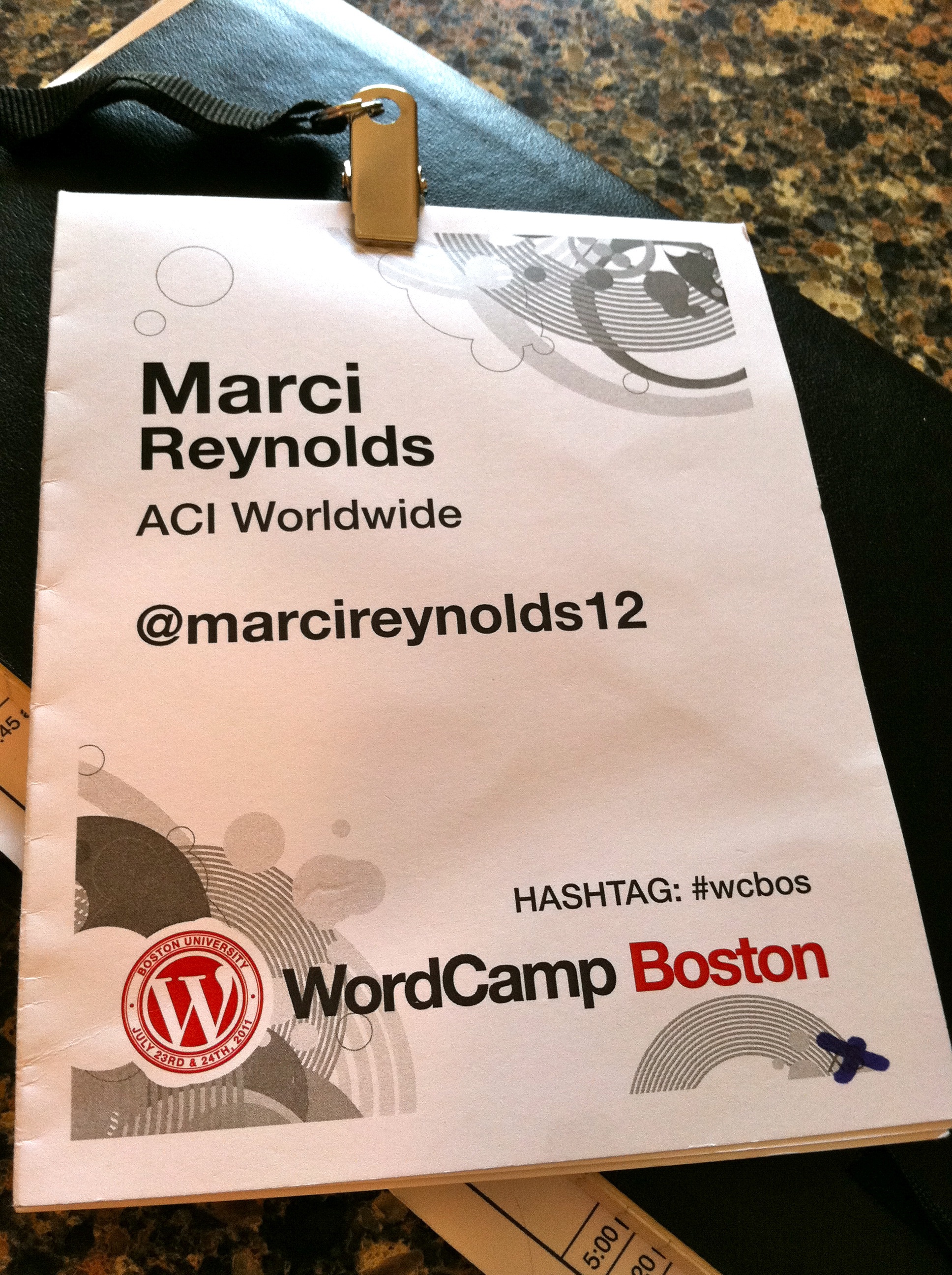
This guest post is by Marci Reynolds of marcireynolds.com.

The July 2011 WordPress wordcamp Boston rocked!  Hundreds of excited WordPress users gathered to look at more than 40 speakers who presented on topics of social media to themes shortcodes for safety.

WordCamp BostonI took detailed comments as I listened, watched and network with blogging and WordPress geniuses and have collected what I consider the most interesting tips and tricks.

Plugins were a hot topic in each session, but only three rose to the top as the "recommended":

yoast seo: can you optimize page titles, meta descriptions, keywords, sitemaps XMLhubspot plugin: you can leverage HubSpot lead nurturing, website analytics and "call to action" message typesGoogle Analytics for WordPress: you can synchronize information with your Google analytics account and you can custom variables and meta-data tracking.

In addition to the hearing on the importance of fresh, high quality content ("content, content, content") strengthened a number of experts this WordPress SEO tips:

Change the default Permalink to blog posts to end up with the name of your post, not the number of the post.Use images to your content, engage readers break down and help with SEO. Make sure you have the image themselves, or they choose in "creative commons", with appropriate credit (one of my favorites is http://www.freedigitalphotos.net/).Use relevant keywords in the image name and alternative textAdd a XML sitemap.Measuring and improving your site loading speed. Google's Matt Cutts has stated that, "We want the web to be faster, we want sites to load fast," so it is quite possible that Google would want to encourage and reward this via their ranking of sites.Google added in May 2011, a Report of the speed of the Site in Google Analytics.For more detailed info, check out the recent blog post on Search Engine Watch, Why marketers should care about Site speed.Build link juice. Not random back links, but high quality links to and from other sites that provide relevant content. (A technique that worked well on my Blog sales operations, is to build a page dedicated to links to other sites with relevant, high quality content. For example, consider this other sales Ops articles . )

I think it is necessary that each 2011 Conference, whether it's about real estate, insurance, or cat food, should include multiple sessions on the use of social media, and WordCamp (WC) part of that group.

However, there was a clear division of labour in the toilet-audience. Some participants TOILET like me, were well versed in the social media 101 and 102 and were looking for something new and advanced. The remaining participants (50% of humans seemed) were beginners and were looking for advice on how to get started. An attendee of the Conference was skewered on Twitter, hashtag # wcbos, to ask how to spell "Mashable". Understandable!

The general themes about how to use social media to support the efforts of your WordPress were:

Make it easy for readers to share your blog content by including parts of buttons in your posts. There are many options of the plugin to facilitate that.Use social media to share your content. You should only share with 50 or 100 followers, but you need to consider the power of the retweet. Per HubSpot have blog posts that are shared on Twitter more page views, while blog messages shared on Facebook more comments.Try to test three headlines on Twitter and see what gets the most click-throughs.

Overall, WordCamp Boston was a great experience, and worth the time and money investments. I saw some very talented speakers, network with other WordPress users and learned many new things. I look forward to attending next year.

Have you participated in an event WordCamp? What have you learned?

Marci Reynolds, based in Boston, MA, is a leader operations per day and an active blogger outside office hours.

She loves writing about social media best practices, sales support, service operations and process improvement. More information about Marci.


View the original article here

Thursday, September 1, 2011

What do fishing and blogging have in common?

This guest post is by Kevin Cullis of MacStartup.com.

"If passion drives you, let reason hold the reins."-Benjamin Franklin

Give a man a fish and you feed him for a day; Teach a man to fish and you feed him for a lifetime; sell him fish supplies and a fishing guide and you have a company.

Most of us start a blog with not much thought other than just to start writing. But at some point you say: "I'm putting in all this time in my blog, how do I make money from it?"

There are two parts of each company, including blogging: there's the craft of your company (graphic art, doctor, lawyer, blogging), then there is the company of your vessel (making a profit from your craft).

Starting a blog first requires the three main questions:

Why are you writing a blog, what is your purpose for writing?How do you get it done, what specific actions you will get the desired results?What will your expected results of writing your blog?

So what blogging and fisheries have in common? Let's take a quick look at points 1 and 3, and a longer look at 2.

Question anybody if they have fished, and most people will say "Yes." However, when asked, "what are the steps to take to go fishing?" most people are stumped.

Blogging is no different. While you can start a blog and start writing posts, it is similar to casting your fishing line in the nearest Lake, pond or stream with no fishing lure, bait on the hook — or even a hook. You must have a good reason to be there.

If you are fishing for fun or the love of fishing, that's one thing: grab some gear and hang the "gone fishing" sign. If you hungry because you're fishing, this takes on a whole new perspective and you will hopefully put in some serious thought, or search for answers to get food on your kitchen table.

Results is done in two ways:

take action and learn from your mistakes and figure out what the best way to get results, orlearn of others and their errors, thus cutting down the time needed to get the results you want.

Learning means having the right answers, and implementing them in the correct order, to increase your chances of catching the fish (writing your blog). Even then, there are no guarantees. So here are the steps to a more successful blog (and catch fish):

Step 1: who is your ideal customer/blog reader? Describe who your ideal clients and, in some detail. You need to know the "fish" that you are fishing for, or that ideal fish tuna, salmon and rainbow trout. If money is no object, you can use the money to travel to Alaska salmon fishing and start paying. Most of us have not, however, that kind of budget, so we grab a fishing rod and head to the nearest fishing hole ejected to a line. Blogging is no different in that you need to know who your audience is and a small enough niche to the expert that everyone goes to.Step 2: which problem solves your solution/blog? What is your audience looking for? What is their ideal solution? In other words, what are your "fish" hungry for? What a salmon eat depends on age, gender and location, and fishing is about finding the right four or five baits or lures that work to increase your chances of catching salmon. Blogging resources providing answers your audience is looking for. You can write blogs and guest blogs all day long with no focus, but you go business-or results-hungry if you don't look at the results of your blog and make the necessary changes. Sometimes blogging, like fishing, requires trial and error to become successful. I blogged about the initial and initials in iWork pages for my book to make because I worked out the solution, and within weeks it became one of my top viewed posts. If you cast the line not never, you get a "bite". Please test and change to get results you want.Step 3: where are your customers/readers? Where they visit, hang, and connect with other readers of their tribe of offline and/or online connections? You need to know where are the ideal locations or "awesome fishing spots" for your customers/readers. Try salmon fishing in the hinterland of Kentucky and you'll be hungry. Write a guest post about Typepad for a WordPress website and you will be rejected because it does not connect with their readers. So, where are your ideal fish.Step 4: why should your customer choose your product/blog about a similar? What makes your product different, better, or make it stand out? Choose the best "bait" on your local fishing shop or what is in your box to tackle for salmon works. Your blog "ACE" has an ideal message for ideal reader's problem. What are the distinctive advantages of your blog from others? What is your hook?Step 5: how to make your customers buying decisions about your product? What makes them Tick about how they choose your product? You must have the ideal technique to lure your "fish". Plop ping just the hook in the water can not attract a fish. It takes a different technique to "hook" every kind of fish. blogging is no different in that your audience is different from those who read books or magazines. Google Analytics gives you the advantage of content change your overnight to "starve" needs of your audience.Step 6: when is the best time to promote your product to your customer? How many times have you to talk with your customers to consider them and then buy your product? You need to know the ideal time to your line to "hook" your fish "objects". Fish have specific times that they feed, which is no different to marketing during the holidays, anniversaries or special events such as weddings. In this case, as with most an audience or customer, you need to cast your line when they are ready to buy, not when you're ready to sell. The great thing about blogs is the internet guest blog "chum" you can spread over the internet "waters." Then upload a relevant post (casting your line and lure) and watch the "chum" guest post lead traffic to your blog site.

These six W — really five w and H — are the basis for creating a successful blog. While it is easy to "spray and pray" your blog the contents with the hope of its success, it is better to look at the results of your post to see where your "hunger" blog reader take you. If you have a blog comment post bite, "Hook 'em, Dano!"

Kevin Cullis is a former officer of the u.s. air force and considers himself as an entrepreneur, Mac Evangelist, Business Geek, man, published author of a book of Mac company, readaholic, analytical, balding. He is the founder of MacStartup.com.


View the original article here

Wednesday, August 31, 2011

Cooperation is the key to blogging success?

This guest post is by Onibalusi YoungPrePro.com's.

I was looking to the sky a few days ago and what I saw made me see how organized even animals can be. I saw about 50 birds flying from a tree to another and by the time they returned, each had a stick in her mouth — they worked on building a House.

This taught me a very important lesson about blogging, and made me realize that every thing around us us to be a better blogger can learn.

If those birds could just work in groups to build their home, then what about our bloggers? Why can't we effectively use the power of collaboration to build of our blogs?

The truth is that the number of new bloggers are trying to build a successful blog single-handedly nowadays is breathtaking. We know that there are more than 152 million blogs in the blogosphere, but we just can't figure out how many successes — as far as we are concerned, the majority of online blogs are failures.

How we then stand out as bloggers? What can we do to encourage our blogs success rates, and our blogs to distinguish it from the 152 million other blogs in the blogosphere? The truth is that we are the answer to this puzzle that a gazillion times have heard, but we've really never considered it as that important.

The key is cooperation.

You've probably heard that you should work together to build a successful blog at least once, but why on earth would you even try? After all, you can praise for building a great blog only claim!

That power could be speed, power, or anything that involved. If you have a look at the case of the 50 birds that I talked about, you'll notice how easy these birds can build what House they want to build in a much shorter timeframe than if the work was done by one of them alone.

It would be difficult for you to kick start your blog, but the strength, cooperation and wisdom of 50 extra bloggers can not be compared. I know that it is almost impossible to get that many bloggers to you, to support, especially if you are very new. But the truth is that you don't need 50 bloggers to support you to build a successful blog — three bloggers work with you to the success of your blog will be a whole lot of difference.

A lot of people will have told you, it takes a lifetime to build a reputation, but do you know that you can build a great reputation in a matter of years with the right tactics?

By linking to the appropriate groups bloggers at the right time, you can easily build a successful blog without moving an inch. Sometimes all you need just the adoption of a successful blogger in your niche. Even if you're not the approval of an A-list blogger, get the approval of two or three bloggers on the same level if you have a whole lot of difference it will make.

The funny thing about getting people to support you is that you don't need a hundred people to support you before you succeed. You only need one or two targeted people.

We human beings are created in such a way that we can easily be influenced by things and people around us, and this to your advantage can use. If you can get the support and approval of two to three other bloggers in your niche, you can easily use that if social proof to get more bloggers to support you, and that approval of these two bloggers can mean the difference between readers think you're cool, or that you don't know what you're talking

When people hear about collaborating with other bloggers in their niche, is the first thing that they try to send an e-mail to a few bloggers asking them as friends or ask the blogger to establish a regular link exchange campaign with them. If that is what you are about to do, then you might as well forget it. Below are a few ways that you with other bloggers in your niche can work together.

We bloggers are one of the smartest people (okay, I'm a blogger and I'm baised — but my point is that we also have common sense), so we take note, when people do something for us.

If you send me a link to tell you today, and you tell me to tweet your post tomorrow, and you tell me to review your product next week, but I have not seen that you share my messages or do me a favor in the past two months, do you think I will do that for you? The next thing I will tell you is, "no, thanks, that is a great offer but I don't think it will work with my audience" — even if it will. But when you are "always" spreading the word about me and to tell people how great I am, even if I have a million followers and you only have one, I will like to spread the word to my followers about you.

When was the last time you sent an email to a blogger to thank them for their blog post? Just try to do it once or twice, and you'll notice that you will be able to request the assistance of that favorite blogger of yours.

We bloggers like it when people say good things about us. We like to be appreciated, and some of us even like to be flattered. Give us what we want will only bring you on our radars.

I'm not trying to say that you must email a blogger and tell him or her that they start your god — that will only increase of an additional flag and put you on the "Beware of list" for that blogger. The best thing to do is a simple and polite email, maybe Mark interesting points in one of their articles to Show the blogger that you really read their messages to send.

Although there are media such as Twitter and Facebook, I still think the best medium to use for this kind of contact is email. I know that Twitter might be the easiest way to get in touch with your favorite blogger, but that is also its weakness. A lot of people, but very few people use email thank you to send messages to bloggers (or at least little in comparison with Twitter). The end result is that sometimes before the blogger can take to your e-mail address, but because you don't really need a response, it's okay. And it's enough to make the blogger to notice you.

Which birds were helping each other.

We must do the same as a blogger.

You won't go far by trying to exploit your fellow bloggers for attention, or links, or anything else, so don't even try to go that route. It might work in the beginning, but it will end up biting you.

The best way to succeed in your efforts as a blogger does everything that you really do. When you make your efforts not only to contribute value to your readers, but also to your fellow bloggers focus, you will eventually get great results for it.

Onibalusi Bamidele is the founder of YoungPrePro.com, a blog where he teaches people How to write for traffic and money. Get his free eCourse 7 series on how to write a successful Online company to build


View the original article here

You should write about making money blogging on Make Money blogging [misconceptions new Bloggers have # 3]

This post is the third in a series of studies of misconceptions and myths about blogging, that many new (and some experienced) bloggers about blogging.

We have already discussed the misconceptions that blogging superhuman effort takes (or is simple!) and that you daily on your blog should books.

Contemporary misconception is all about money. It is one that I hear every day when I observe what people are saying about making money from blogging.

Only people who sell make money blogging resources, make money blogging.The most profitable topics to blog about his blogging tips of making money blogging.It is impossible to make money blogging on "normal" everyday topics.

The reality is that most people who talk about making money blogging those trying to create a name for himself in that very niche. I think part of the creation of authority and credibility is to show what you are doing, so that bloggers in this niche are often not Wars of their revenue share.

On the other hand, many bloggers who are making a living from blogging in other niches don't have an avenue through which to talk about it, or don't want to (for privacy reasons or because they don't want to warn the competition to their success).

As a result, is the impression that new bloggers often get that nobody is making money blogging with the exception of a letter about writing.

Let's see some of the realities of working in this niche.

You good money blogging about blogging. It is true — there is money to be made in this space. Teaching others blog and that a life of it can be profitable. I make enough to live (and some) from ProBlogger every month, and know of at least five or six other bloggers in your niche that on a comparable level would be. As with any subject that has nothing to do with money, this can be a lucrative niche.It's been a busy niche when it comes to finding readers. As a result of the success of a number of (and the public service broadcaster of results), many others joined the hunt for market share in this space. I have not seen figures on it, but I suspect that the result is that it is one of the more crowded niches. As a result, can break into the niche and making a name for yourself can be tough.It's been a busy niche when it comes to products. If you want to make money in the niche Make Money blogging by releasing a product, there are not only a lot of other blogs, but a lot of products that you will have to compete with. Not a day goes by when I'm not approached by another blogger like me to their e-book, course or tool ... Again, it is difficult to distinguish, and I suspect that many bloggers already have bought just enough products, and are not so interested in buying more.There's a lot of suspicion about the topic. Thanks to the nature of the subject has a lot of suspicion about it. Unfortunately, over the years, this niche has attracted its fair share of dubious characters and those less-than-ethical and transparent tactics have used to make a name for itself. This has a lot of suspicion among the public about the niche. I'm kind of glad about this suspicion, I like a lot of people who've seen scammed, but it makes this a tricky area to work in. My recent ban on (and then reinstatement) of YouTube seems to have occurred because many in the niche were tarred with the same brush (most of the accounts had made an end of videos including the words "make money online").Bloggers are perhaps more reluctant to spend money than other target groups. Let us be clear: I'm not calling you cheap! But one of the factors to consider in this area is that the barriers to entry for the blogosphere (unlike other hobby) are very low. You can setup a blog for free, there are thousands of blogging themes, tools, and how-to instructions there for free, and there is plenty of free help within the niche. As a result, many bloggers don't come to their blogs with the expectation of having to spend a lot of money. This can affect the bottom line for those who try to operate in this niche (I will touch on this more below).

I'm not going to pretend that all other lucrative niches. I know a lot of bloggers with decent readerships that are struggling to make money, because their subjects do not lend themselves for monetization. However, my experience teaches me that there is definitely a lot of opportunities in other niches, and that in many ways they can make it easier to make money than the niche blogging tips.

Personally, I have found it a lot easier to build significantly larger audience and higher profits in other niches. My photography blog has about five to six times the readership of ProBlogger, and is more than five to six times as profitable.

The niche photography is very competitive, but there are some other so quickly including:

The market is larger: There are a lot more people around who own cameras than blogs.The audience is more of a public expenditure: I mentioned above that since blogging has low barriers to entry, bloggers are often less likely to spend money. Photography is a little different. People increasingly spend thousands of dollars on cameras, they buy photography magazines and books, they enroll in courses ... There is just more of a willingness to bring in that niche.The audience is not as suspicious: While people still a healthy suspicion of online marketers in this space, there are fewer barriers on this front.

This assessment is not only relevant to the photography space — plenty of other niches are also bigger and his audience that more be used for expenditure.

This is probably not the place for a full exploration of how a niche for your blog (I will also be some links below for more information about that). My general opinion is, however, to choose a topic on which there is a healthy demand for content (it's hard to have a successful blog about a topic that nobody but you bought) and that you know something about (and preferably have a passion or interest).

My co-author on the ProBlogger book, Chris Garrett, last year on the day of the training ProBlogger presented in Melbourne, and used a slide which I think is a great Visual at this point:

blog-this-niche.png


View the original article here